How to Use a 360 Photo Booth Outdoors: Sun, Wind, Ground, Rain and Power
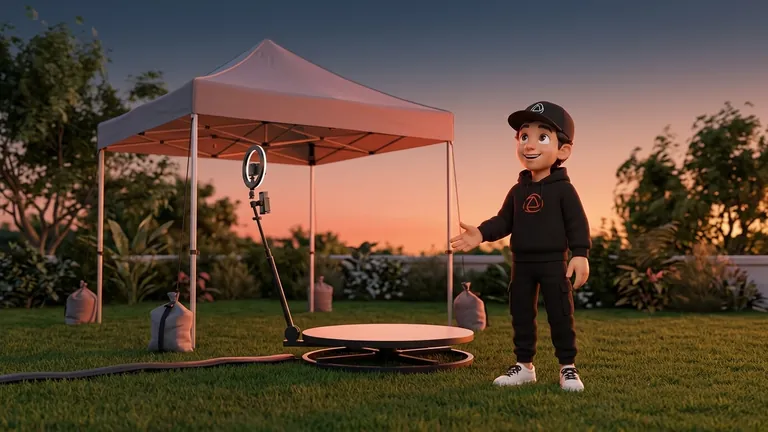
You can use a 360 photo booth outdoors if you set it up under cover, anchored, on firm level ground and with reliable power, and if you agree beforehand on what happens when the weather does not cooperate. Sun, rain, wind and a distant outlet are the four problems that come up most in industry guides.
This guide collects what Fotomaster, Photo Booth Supply Co., Check Cherry and Reservety publish. All four are US photo booth software and equipment companies, so their figures are in feet, degrees Fahrenheit and US voltage; we add metric conversions as approximations only. Where there is no comparable source, we give criteria, not numbers.
At a Glance
- Cover: a tent or canopy that covers the top and shields against wind-driven rain, because the electronics must not get wet.
- Sun: shade for the screen and the gear, because direct sun makes screens hard to read and heats the electronics.
- Wind: weight on the tent and nothing that acts as a sail, such as backdrops or banners. Set a limit before you sign.
- Power: outdoor-rated extension cords of at least 50 feet (about 15 m) according to Fotomaster, a surge protector and a backup plan.
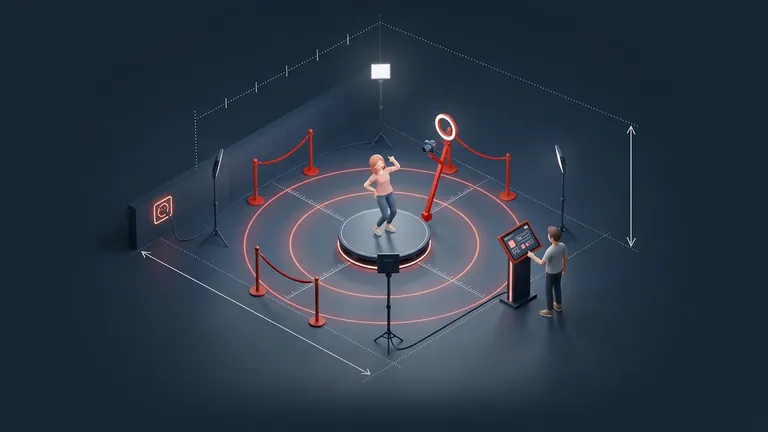
- Space: the 12 to 14 foot diameter (3.7 to 4.3 m) and 10 foot ceiling (about 3 m) of a 360 booth also apply under a tent.
Sun and Heat: Shade for Screen and Gear
Fotomaster, which sells and supports photo booth equipment, recommends avoiding direct sunlight on screens and placing the booth in shade or under a canopy. It also says most electronics operate safely between 50 and 95 degrees Fahrenheit (10 to 35 degrees Celsius), that you should monitor equipment temperature, and that in hot weather you should keep air moving around the booth and camera. In cold weather, let the equipment warm up before powering it on.
Photo Booth Supply Co. recommends a white tent to keep white balance right, which is the setting that stops the image from getting a color cast. If you record video, remember that flash is not an option: the light has to be continuous, as we explain in the lighting guide for a 360 photo booth. With strong backlight, turn the setup so the sun is behind the camera or to one side.
Rain and Wind: Cover, Weight and Limits
The common rule is that electronics should never run in the rain without full overhead protection. Fotomaster asks for a tent, canopy or covered structure that shields from above and from wind-driven rain, plus waterproof covers for transport and setup, and silica gel packets in the equipment cases.
For wind, the answer is weight. Fotomaster advises sandbags or weighted bases and avoiding backdrops or banners that act as sails; Photo Booth Supply Co. suggests securing the tent with sandbags and cinder blocks. Neither gives quantities or a wind limit.
Check Cherry, management software for photo booth businesses, does give an example of contract limits: operating between 45 and 85 degrees Fahrenheit (about 7 to 29 degrees Celsius) with sustained wind below 10 mph (about 16 km/h), covered overhead and on two or more sides, and an indoor backup location available to the client. The article itself says these are example values and not a standard. Use them as a starting point and set your own from your equipment, whose real limits are in the manufacturer's documentation.
| Condition | What to do | Source |
|---|---|---|
| Rain | Full overhead cover and side protection; waterproof covers | Fotomaster |
| Wind | Sandbags or blocks; no backdrops or banners that act as sails | Fotomaster, Photo Booth Supply Co. |
| Direct sun | Shade or a canopy; ventilation; a shielded screen | Fotomaster |
| Cold | Let equipment warm up before powering on and carry spare batteries, because cold drains them faster | Fotomaster |
| Weather outside limits | An indoor plan B agreed in writing | Check Cherry (example clause) |
Ground and Space: Level, Firm and Measured on Site
Reservety, reservation software for photo booths, publishes for the 360 a circular clear area of at least 12 to 14 feet in diameter (3.7 to 4.3 m) and a ceiling of 10 feet or more (about 3 m) for the arm. It adds that tents and outdoor venues can have variable heights, so you must measure at the exact setup spot. For the detail on each figure, see how much space a 360 photo booth needs.
We did not find a reliable source with a maximum slope or level tolerance for a 360 platform, so we give no number. The criterion is practical: the platform must sit level and must not move when a person steps on, and if the ground is uneven or soft, check your platform's manual first. Photo Booth Supply Co. suggests carpets to protect equipment and hide cables.
- Grass or soft soil: check that the platform does not sink or tilt under weight, and use boards or a rigid base if needed.
- Slope or uneven paving: look for another spot on the site before thinking about shims.
- Wet ground: damp ground under the platform and cables is a safety risk; dry it or move the setup.
- Tent height: measure the ceiling at the center and at the edge, not just at the highest point.
Power: Cords, Protection and Plan B
Outdoors the outlet is often farther than expected. Fotomaster recommends confirming power availability in advance, using outdoor-rated extension cords of at least 50 feet (about 15 m), putting a surge protector between the outlet and the equipment, testing all connections before starting and carrying more cords than you think you need. Reservety indicates an outlet within 50 feet of the setup.
Check Cherry describes a dedicated 110 V, 10 A outlet within 25 feet (about 7.6 m) as typical. That is US data, so outside North America what matters is the power your equipment draws, which you will find on its label or manual. Fotomaster and Photo Booth Supply Co. suggest carrying a portable generator as a backup at remote venues; neither gives a wattage, so work out yours by adding up platform, lights and devices.
Connectivity counts too. Fotomaster recommends confirming internet connectivity and carrying a mobile hotspot as a backup. If the venue has no signal, record anyway: Snap360App saves 360 videos to the device gallery with no Wi-Fi or mobile data and uploads them when the connection returns. We explain it in how to record offline.
Operator Checklist and What to Agree First
- Visit or photos of the venue: ask about ground, shade, tent ceiling and distance to the outlet.
- Weather plan: set the wind and rain limit and the indoor backup in writing, like the Check Cherry example clause.
- Early arrival: Reservety counts about 30 extra minutes of setup outdoors; Fotomaster recommends arriving earlier than for an indoor event.
- Outdoor kit: weights, covers, extension cords, a surge protector, batteries and a mobile hotspot.
- Full test: record a video in the actual light before opening the line.
All of this should be reflected in the agreement, as we suggest in the 360 photo booth rental contract guide. To record and share without depending on the network, you can see the plans and start with the Free Plan, no card and no time limit.
Frequently Asked Questions
Can You Use a 360 Photo Booth Outdoors?
Yes, with full overhead cover, weight against the wind, firm level ground, reliable power and a plan for bad weather. Industry guides agree on these points.
What Happens If It Rains at a 360 Photo Booth Event?
The electronics must not run in the rain without full cover. Fotomaster asks for a tent or structure that covers the top and shields from wind-driven rain. If there is no cover, move the booth to an indoor spot agreed in advance.
How Much Wind Is Too Much for a 360 Photo Booth?
There is no universal limit. Check Cherry uses sustained wind below 10 mph (about 16 km/h) as an example clause, but says it is only illustrative. Check your equipment and tent limits and agree your own in writing.
How Do I Protect a 360 Photo Booth from the Sun?
With shade or a canopy. Fotomaster warns that direct sun makes screens hard to read and that electronics operate safely between 50 and 95 degrees Fahrenheit (10 to 35 degrees Celsius), so keep air moving around the equipment.
What Ground Does a 360 Platform Need?
Level, firm and dry ground where the platform does not move when someone steps on. We found no comparable published maximum slope, so check your platform's manual and test with weight before the event.
How Much Power Does an Outdoor 360 Photo Booth Need?
It depends on the equipment. Check Cherry describes a dedicated 110 V, 10 A outlet within 25 feet as typical in the US. Check your own equipment's draw, use outdoor-rated cords and carry a backup generator.
Does Snap360App Work Without Internet at an Outdoor Event?
Yes. Snap360App records 360 videos with no Wi-Fi or mobile data and saves them to the device gallery. When you get a connection back, you can upload them to the cloud and share them with a QR code.
How Much Space Does a 360 Photo Booth Need Under a Tent?
According to Reservety, at least 12 to 14 feet in clear diameter (3.7 to 4.3 m) and a 10 foot ceiling (about 3 m). Measure the tent on site, because the height can vary.