How to Build a DIY 360 Photo Booth Platform: What You Save and What It Risks
Yes, you can build a DIY 360 photo booth platform, but the saving is limited to one piece of the business, and in return you take on the safety, the time and the risk yourself. The camera, the light, the software and the insurance cost the same whoever builds the platform, and a platform people stand on has to survive weight, jumping and dancing.
We found no reliable guide with the real cost of building an event-grade 360 platform, so this guide does not invent a saving figure. It uses published selling prices from Simple Booth and Reservety (US data, in dollars), a manufacturer patent about how these platforms fail and tutorials for rotating turntables for product photography, and it gives you a method to run the numbers with your own costs.
At a Glance
- Possible, yes: there are tutorials for motorized turntables, but they are meant for photographing small objects and none we saw gives a maximum load.
- Limited saving: only the platform changes. Camera, light, software and insurance cost the same.
- Real risk: a patent describes the central shaft and the platform edge as the points that fail when several people stand on it.
- Your time counts: the real saving is the selling price minus parts, hours and testing, not just the selling price.
- Rule of thumb: if you cannot show the load it holds, do not put guests on it.
Which Part of the Cost Changes If You Build It
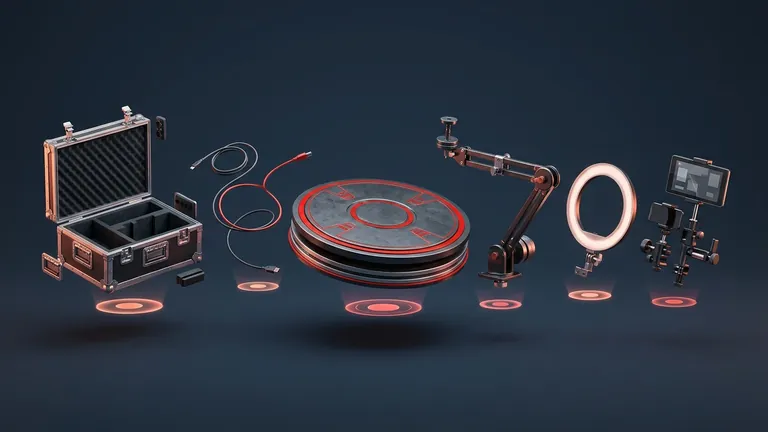
A 360 photo booth is the sum of platform, camera, light, software and insurance. Building only touches the first one. This table shows the ranges published by the sources we found, all from the US and in dollars:
| Part of the business | Does it change if you build? | Published reference |
|---|---|---|
| Platform or complete booth | Yes, it is the only thing you replace | Simple Booth: a manual 27-inch model, a bit over $1,000; motorized Amazon-brand models, $1,899 to $3,299; premium, from $3,490 up. Reservety lists the 360 platform at $1,500 to $3,000 |
| Camera | No | Simple Booth: $279 to $1,999 depending on the model |
| Light | No | Reservety: a ring light or softbox, $80 to $200 |
| Capture software | No | Reservety: $300 to $800 once, or $30 to $80 a month |
| Liability insurance | No, and it can get complicated | Simple Booth: $1M of general liability typically costs $400 to $700 a year |
| Total to set up a 360 | Only the platform part goes down | Reservety: $7,000 to $10,000 in total |
Reservety sells booking software and Simple Booth sells software and equipment for photo booths, so these are industry vendor figures. They are not a quote. What matters is the proportion: even if you saved half the platform cost, the rest of the setup is still there. The full breakdown is in how much it costs to set up a 360 photo booth.
What You Have to Solve When Building It
The tutorials we found (several on Instructables, for example) cover rotating turntables with a DC motor and speed controller or a stepper motor, meant for photographing small objects. They are a good starting point to understand the movement, but none we saw gives the maximum load of the bearing, the motor or the board. For a platform that carries people you need to solve, at minimum:
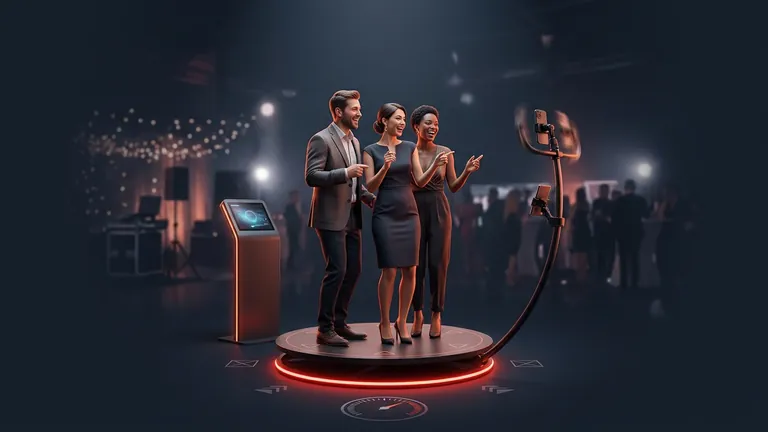
- Load and bearing: the load is shared between the central shaft and the edge. A Shenzhen Vanplex patent (US12276901B2, published in 2025) describes that, with three to six people near the edge, single-shaft platforms tend to deform, and that jumping and big movements concentrate the force on the shaft until it loosens or breaks. It is a manufacturer talking about the competition, but it points at exactly the places you need to calculate.
- A motor with enough torque: turning a standing person takes far more torque than turning an object on a table. Without a datasheet for the motor and gearbox, it is a guess.
- Off-center stability: the same patent mentions that if someone stands to one side, the platform can shift and become unstable.
- Camera and arm: Simple Booth warns that mounting a heavy camera, such as a DSLR, on the arm shifts the center of gravity and makes the rig more unstable, dangerous and fragile.
- Emergency stop and cables: a rotating platform with people on it needs to stop instantly and have no cables that can tangle.
Build or Buy: Comparison
| Criterion | DIY platform | Bought platform |
|---|---|---|
| Parts cost | You work it out. There is no source with reliable figures | Published, fixed price |
| Your time | Design, sourcing parts, assembly and testing | Unbox and test |
| Maximum load | Whatever you prove with your own tests | What the manufacturer states on its spec sheet, which is worth getting in writing |
| Safety | Entirely your responsibility | Shared with a manufacturer that designs and tests it |
| Failure at an event | You repair it, often without spare parts | Depends on the seller's warranty and support, which you should check |
| Insurance | Ask your insurer whether it covers equipment you built | Usually starts from identifiable commercial equipment, but confirm it too |
| Image with the client | Depends on the finish | Professional equipment out of the box |
Being homemade does not make something worse or cheaper by definition. What changes is who proves it is safe. For a reference on what commercial platforms hold, see how many people fit on a 360 platform.
How to Work Out Your Real Saving
With your own numbers, in this order:
- Write down the selling price of the commercial platform you would buy, with shipping and taxes.
- Add up the parts for yours: motor, gearbox, controller, bearing, board, frame, wiring, emergency stop and finish.
- Add your hours of design, assembly and testing, valued at what you would charge for them.
- Add the cost of failing: a part that does not work and has to be redone, or a lost event if it breaks.
- Subtract: selling price minus all of the above. If the result is small or negative, buy.
If the goal is a lower upfront investment, there is a simpler route: start with an entry-level unit sold with a stated load, and reinvest with your first events. The numbers for the whole business are in insurance and license for a photo booth business.
When Building It Makes Sense
- For your own use, with no guests on it: recording your own videos or testing the idea, without selling the service.
- If you can calculate structures and mechanics and can document the load it holds.
- If your insurer confirms in writing that it covers equipment you built.
In every other case, especially if you will rent to whoever hires you and people will stand on it, a platform with a manufacturer-stated load is the more prudent choice. And the software is the part you do not need to build: Snap360App records offline and lets you customize the video with frames and music, so the platform is the only piece you have to solve. You can see the plans and start with the Free Plan, no card and no time limit.
Frequently Asked Questions
Can You Build a DIY 360 Photo Booth Platform?
Yes, there are tutorials for motorized turntables, but they are meant for small objects and none we saw gives a maximum load. For people you have to calculate the bearing, motor and structure yourself.
How Much Do You Save by Building It?
There is no reliable figure, because we found no source with the real cost of building one. Only the platform is replaced: camera, light, software and insurance cost the same. Work out the saving as selling price minus parts, your hours and the cost of a possible failure.
How Much Does a 360 Platform Cost to Buy?
According to Simple Booth, in the US and in dollars: a bit over $1,000 for a manual 27-inch model, $1,899 to $3,299 for motorized Amazon-brand models and from $3,490 for premium ones. Reservety lists the 360 platform at $1,500 to $3,000.
Is It Safe to Put People on a Homemade Platform?
Only if you have checked the load it holds. An industry patent points at the central shaft and the edge as the places that fail with several people, jumping or big movements. Without a proven load, it is better not to put guests on it.
Can I Rent Out a Platform I Built Myself?
Legally it depends on your area, and in practice on your insurance. Ask your insurer in writing whether it covers equipment you built, and put the maximum occupancy in your contract.
Is It Worth Building One to Start the Business?
Usually not. The saving affects a single part, it takes time you could spend winning events and it carries the safety risk. The usual route is to buy an entry-level unit with a stated load and reinvest.
What Else Do I Need Besides the Platform?
A camera able to do slow motion, your own continuous light, a device with the app, and insurance. With Snap360App you record offline and deliver the video with frames and music.